How to Plan a Europe Trip Without the Stress in 2026
So, you’re planning a trip to Europe. It’s an exciting thought, but the secret to an amazing adventure lies in giving yourself enough time to get organized. My advice? Start thinking about it six to nine months ahead of time. This isn't just about avoiding last-minute stress; it's the best way to snag good deals on flights and hotels before they disappear.
Laying the Groundwork for Your European Adventure
A truly great Europe trip doesn’t start with booking a flight—it starts with a conversation. The first, most crucial step is getting everyone on the same page, especially if you're traveling with friends or family. Turning those "wouldn't it be cool if..." daydreams into an actual plan means sorting out the big questions early on to avoid the classic "too many cooks in the kitchen" chaos later.
Before you even start Googling pictures of the Colosseum, you need to align on the fundamentals. When can everyone actually go? What’s a realistic budget? And what does everyone really want to get out of this trip?
Establishing Your Core Travel Parameters
Getting this information nailed down from the start is a game-changer. Instead of descending into a messy, never-ending group chat, I've found that a simple survey or shared document is the best way to get clear answers from each traveler.
Here’s what you need to ask:
Timing and Duration: Find out everyone's availability. A two-week trip in June looks very different from a ten-day trip in October in terms of cost, weather, and crowds.
Budget Expectations: Get a feel for a comfortable daily spending range for each person. This avoids so many awkward money conversations down the road. Is this a backpacker's budget or a five-star getaway?
Travel Style: Are you trying to see ten cities in ten days, or would you rather settle into a couple of spots and really explore? Figure out if your group prefers bustling cities like Paris, quiet countryside escapes in Tuscany, or sunny beaches in Santorini.
Must-See Destinations: Ask everyone for their top three non-negotiable cities or experiences. You’ll quickly see where your interests overlap, whether it’s exploring ancient ruins in Athens, wandering the souks of Marrakech, or hitting the tapas bars in Barcelona.
Once you have this data, you can spot the common ground and start building an itinerary that makes everyone happy. You can get a head start on this with our free trip planning template, which is built specifically for organizing group travel.
Creating a Realistic Planning Timeline
It's no secret that Europe is a huge draw. The continent welcomes a staggering 51% of all international tourist arrivals, with perennial favorites like France, Spain, and Italy pulling in tens of millions of people every year. This massive popularity means that planning ahead isn't just a good idea—it's essential.
A well-structured timeline is the difference between a frantic, last-minute scramble and a calm, organized lead-up to your vacation. The goal is to spread out the tasks so that nothing feels overwhelming.
This visual timeline breaks down the key stages to help you map everything out.
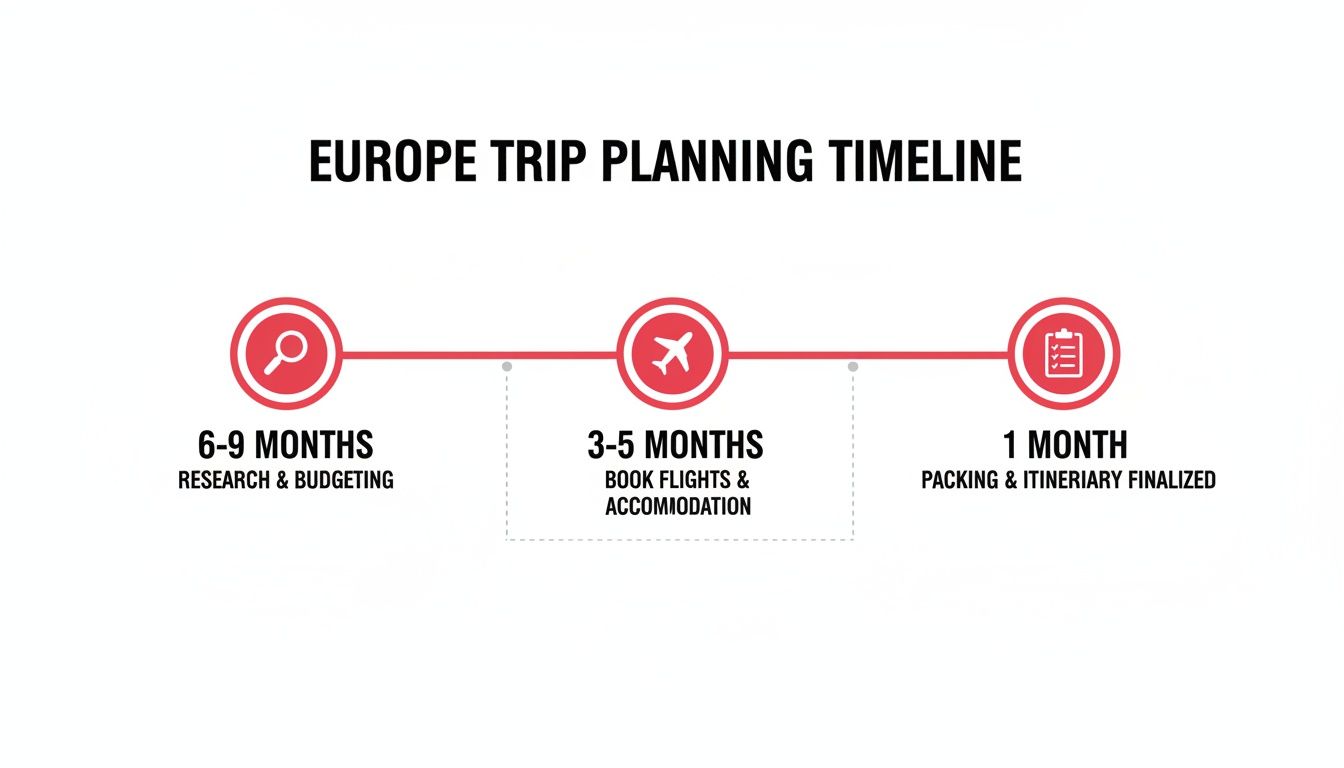
As you can see, the most important decisions and research happen in that 6-9 month window. That’s your sweet spot.
To make this even more concrete, I've put together a countdown checklist. Following a timeline like this turns a huge task into a series of small, manageable steps.
Europe Trip Planning Timeline: A 6-Month Countdown
This table provides a structured timeline to help you organize your planning process, from initial brainstorming to final preparations.
Timeframe | Key Planning Milestones | Group Action Items |
|---|---|---|
6-9 Months Out | Brainstorm destinations. Set a rough budget. Determine trip length. | Send out a planning survey. Vote on top 3 destinations. Agree on budget range and trip dates. |
4-6 Months Out | Finalize route and cities. Book transatlantic flights. Research visa requirements. | Lock in the itinerary. Confirm everyone has booked their main flights. Start accommodation research. |
3-4 Months Out | Book all accommodations. Book major inter-city transport (trains/flights). | Split accommodation booking duties. Finalize and book all major travel between cities. |
1-2 Months Out | Purchase travel insurance. Apply for any necessary visas. Book key tours or activities. | Confirm everyone has insurance. Vote on and book must-do tours (e.g., museum tickets, day trips). |
2-4 Weeks Out | Plan daily activities. Create a packing list. Notify banks of travel dates. | Build a shared daily itinerary. Share packing tips. Everyone calls their bank/credit card companies. |
1 Week Out | Pack your bags. Download offline maps and documents. Confirm all reservations. | Final check-in with the group. Share flight details and meeting points. Get excited! |
By starting early, you give yourself the gift of choice—better flight times, more accommodation options, and a much lighter load on your wallet. The first few months are all about research and getting aligned, which makes everything that follows—like booking trains and activities—so much easier. This is how you set the stage for a truly unforgettable trip.
Crafting an Itinerary Everyone Will Love
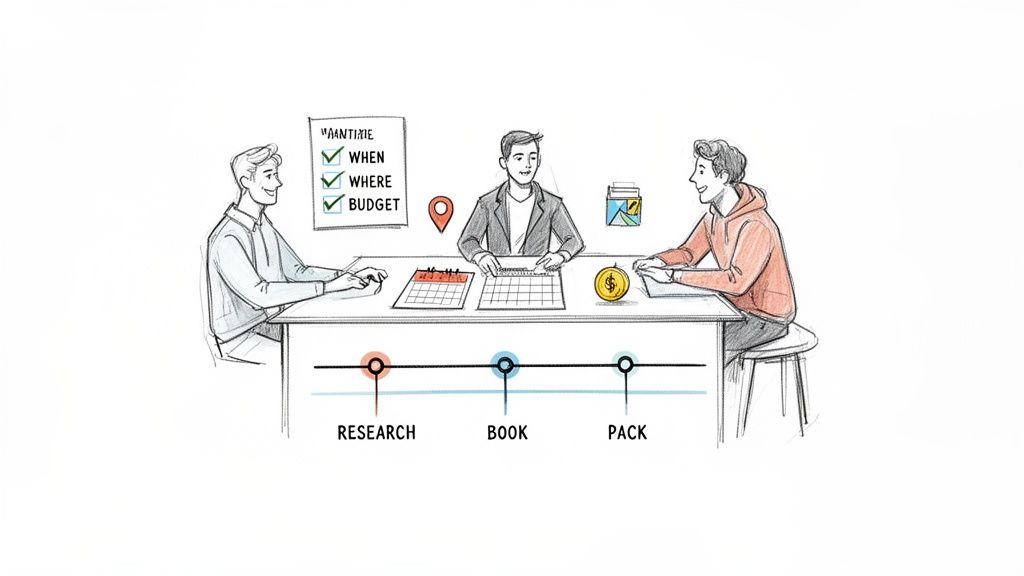
With the big decisions sorted, we’re on to the best part of planning a trip to Europe—dreaming up the actual adventure. This is where you get to connect the dots and turn your group's collective wish list into a real, flowing journey. The trick is to find a common thread that ties everyone's different interests together.
Think of it like creating a story for your trip. This helps you move from a random list of cities to a journey that makes sense and feels deeply satisfying. Every stop should feel like it logically follows the last, creating a well-crafted experience rather than a chaotic checklist.
Blending Interests into a Cohesive Theme
Let’s say your group survey reveals a mix of history buffs, passionate foodies, and people who just want breathtaking scenery. Instead of trying to satisfy each person separately, you can weave these passions into one fantastic route.
The "Ancient History, Modern Cuisine" Route: Imagine kicking things off in Rome, where the Colosseum and incredible pasta live side-by-side. From there, a high-speed train could whisk you away to Florence for Renaissance art and Tuscan cooking classes. Finish in Paris, exploring world-class museums before diving into the city's legendary patisserie culture.
The "Coastal Charm and Scenery" Route: For a group that loves sun and sea, you could start in Dubrovnik, walking the iconic city walls. Then, spend a few days island-hopping along Croatia’s Dalmatian Coast before catching a flight to Santorini for its world-famous sunsets and cliffside villages.
This thematic approach makes planning so much easier. Every city you add has a purpose that everyone in the group can get excited about. If you’re hitting a wall with group decisions, our guide on how to plan a group trip is packed with more strategies for getting everyone on the same page.
Finding the Right Travel Pace
Here’s one of the biggest lessons I’ve learned from years of European travel: don't try to cram too much in. Europe might look compact on a map, but underestimating travel time is the classic recipe for a miserable, burnt-out trip. A great itinerary isn't about how many pins you can drop on a map, but how well you actually experience the places you visit.
Pacing is everything. It’s what separates a relaxing vacation from a frantic, exhausting race against the clock. Remember, every time you move cities, you’re sacrificing at least half a day. Between packing up, checking out, getting to the station or airport, the journey itself, and finally settling into your new place, a huge chunk of your day is gone.
A good rule of thumb is to allocate at least three full days for major hubs like London, Paris, or Rome. For smaller, more focused destinations like Prague or Dubrovnik, two full days can be plenty.
This gives you enough breathing room to see the highlights without sprinting from one to the next. More importantly, it leaves space for the magic to happen—stumbling upon a hidden courtyard, getting lost in a winding alley, or just enjoying an extra hour at a sidewalk café. These are the unplanned moments that become the best memories.
Building a Logical Route
Once you have your cities and pacing down, it's time to connect the dots on the map. A logical route is your best friend—it saves time, money, and energy, leaving more of your vacation for pure enjoyment. The goal is to create a path that flows in one direction and avoids backtracking.
For instance, a classic Central Europe "Golden Triangle" itinerary might start in Prague, move to Vienna by train, and end in Budapest. It’s a natural, efficient progression. On the other hand, flying from Lisbon to Athens and then back to Barcelona would be a logistical nightmare of wasted time and money.
It’s no surprise that short city breaks are incredibly popular here. In 2022, nearly a quarter of all tourism trips by EU residents were abroad, with short jaunts of 1-3 nights making up a massive 56.4% of those journeys. This highlights just how much Europeans value efficient travel. Spain, a master of tourism, captured 22% of all tourist accommodation nights in the EU that year. You can explore more European travel statistics on Eurostat's website.
Building a balanced itinerary is an art, but by focusing on a central theme, setting a realistic pace, and mapping a logical route, you’re well on your way to crafting a European adventure that everyone will be talking about for years to come.
Budgeting and Booking Your Trip Like a Pro
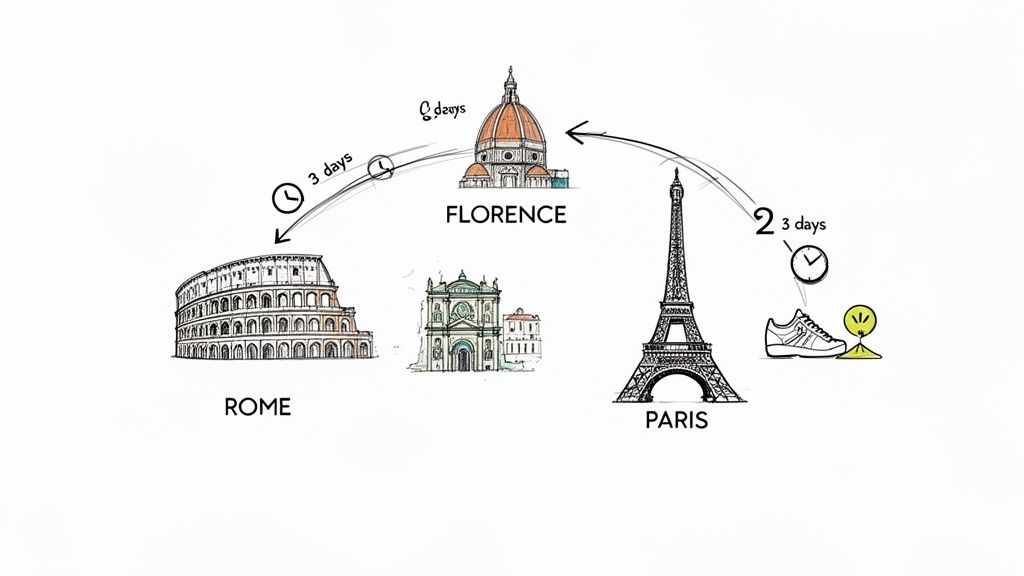
Alright, let's talk about the fuel for your adventure—money. A solid budget is what turns your dream plan for a Europe trip into a reality. Getting a handle on your finances early on means you can make smart decisions, ditch the stress, and just focus on having an incredible time.
Think of your travel budget as your roadmap to freedom, not a set of restrictions. It gives you a clear-eyed view of what’s actually possible, helping you align your grand plans with your bank account. You’ll need to figure out the big pre-trip costs, like flights and hotels, but also all the little things you'll spend money on once you're there.
Breaking Down Your Trip Costs
The best way to start is by splitting your spending into a few main buckets. For any trip to Europe, your costs will fall into two major categories: the big-ticket items you book before you go, and all the daily expenses you'll have on the ground.
Your Major Pre-Trip Expenses Will Include:
International Flights: This is almost always the biggest single purchase.
Accommodations: Your second-largest cost, whether you’re booking hotels, hostels, or vacation rentals.
Intra-Europe Transport: Think high-speed trains, budget airline flights, or a rental car for getting between cities.
Travel Insurance: This is non-negotiable. It’s a small price to pay for critical peace of mind.
Once your plane touches down, your daily spending starts. This is where your personal travel style—be it budget, mid-range, or luxury—really shows. These are the costs for everything from your morning espresso to a late-night gelato.
Estimating Your Daily Spending
Daily costs swing wildly from one city to the next. A pint of beer in Prague, for example, is going to set you back a lot less than one in Paris. To build a realistic budget, you need to look at city-specific estimates that match the level of comfort you’re after.
Here’s a rough guide for what to expect to spend per person, per day in a few popular European cities. This usually covers food, getting around on local transit, and one or two smaller activities.
City | Budget Traveler | Mid-Range Traveler | Luxury Traveler |
|---|---|---|---|
Lisbon | €50 - €70 | €90 - €150 | €250+ |
Barcelona | €60 - €80 | €100 - €170 | €300+ |
Amsterdam | €70 - €90 | €130 - €200 | €350+ |
A "budget" approach might mean staying in hostels, grabbing food from local markets and bakeries, and sticking to public transport. "Mid-range" usually involves boutique hotels, casual sit-down dinners, and the occasional Uber. "Luxury," of course, opens up fine dining, private tours, and five-star stays.
Pro Tip: I always, always add a 10-15% buffer to my total budget. This is your safety net for the unexpected—a missed train, a souvenir you just have to buy, or a spontaneous day trip you didn't plan for.
Booking Flights and Accommodations Smartly
Once you have your budget, the booking can begin. Your flight across the Atlantic is the first big piece of the puzzle, and it usually comes down to a choice between a standard round-trip ticket and a more strategic multi-city ticket.
A round-trip ticket (flying into and out of Paris, for instance) often looks cheaper at first. The catch is that it forces you to circle back to your starting point, which eats up both precious vacation time and money for the return journey.
For nearly any trip involving multiple cities, a multi-city ticket (like flying into Rome and home from Amsterdam) is the way to go. It might cost a little more upfront, but it saves you from a time-consuming and expensive backtrack. In the end, it’s a much more efficient and valuable way to plan your route.
When it comes to where you'll stay, groups almost always get the best deal with vacation rentals. You get more space, a kitchen to cook some of your own meals (a huge budget-saver!), and a living room to hang out in. For couples or solo travelers, boutique hotels or even private rooms in upscale hostels can offer a great mix of value and social connection. If your dates are flexible, you can often find some amazing last-minute vacation deals right on our site.
By breaking down your costs and making a few key booking decisions, you can turn a potentially overwhelming financial task into a manageable part of your plan for a Europe trip. That financial clarity lets you travel with confidence, knowing you’re set up for a smooth and unforgettable adventure.
Navigating Visas, Accommodation, and Transport
Okay, you've got your dream destinations mapped out and a budget in place. Now comes the part that can feel a bit overwhelming: the logistics. This is where your trip transforms from an idea into a reality, and getting these details right is what separates a smooth, incredible adventure from a stressful scramble.
Let's start with the paperwork, because it's the one thing you can't put off. For many travelers from places like the US, Canada, or Australia, visiting Europe is refreshingly straightforward. You can typically enter the Schengen Area—a bloc of 29 countries—for up to 90 days for tourism without needing a visa.
That said, you should always double-check the specific rules for your nationality, as they can change. It's also critical to be aware of the upcoming European Travel Information and Authorisation System (ETIAS). Once it's fully rolled out, travelers from visa-exempt countries will need to get this simple online authorization before heading over.
Your Essential Document Checklist
Before you get lost in the excitement of booking trains or finding the perfect hotel, take a moment to get your documents in order. Trust me, sorting this out now will save you a world of headaches later.
Passport Validity: This is a classic "rookie mistake." Check your passport’s expiration date right now. Most European nations require it to be valid for at least three to six months after you plan to leave Europe. Don't get turned away at the airport!
Travel Insurance: Simply put, don't leave home without it. Good travel insurance is your safety net for everything from unexpected medical issues and trip cancellations to lost bags.
Proof of Onward Travel: Always have a copy of your return flight reservation accessible.
Accommodation Confirmations: Keep digital or printed copies of every booking.
I’ve learned this the hard way: keep everything in one place. Create a folder in the cloud (like Google Drive) and also carry a slim physical folder with printouts. When an airline agent asks for a booking number you can’t find in your email, that little backup folder feels like a superpower.
Choosing How You'll Get Around Europe
Moving between cities is where the real adventure unfolds. The way you choose to travel—by train, plane, or car—will fundamentally shape your experience, your schedule, and your budget. Each has its place, and the smartest travelers learn to use them all.
Comparing Transport Options for Your Multi-City Europe Trip
Deciding how to get from Point A to Point B isn't always simple. A high-speed train might be perfect for one leg of your journey, while a budget flight is better for another. This table breaks down the pros and cons to help you choose the right transport for each part of your trip.
Transport Mode | Best For | Average Cost | Pros | Cons |
|---|---|---|---|---|
Trains | City-to-city trips under 5 hours; scenic routes. | €50 - €150+ | Arrives in the city center; relaxing with great views; generous luggage policies. | Can be expensive if not booked in advance; slower for long distances. |
Planes | Long distances (e.g., Lisbon to Athens); crossing water. | €40 - €200+ | Very fast for covering large areas; budget airlines offer cheap fares. | Airport travel time; baggage fees; security hassles; airports are often far from the city. |
Rental Cars | Exploring the countryside (Tuscany, Provence); remote areas with poor public transport. | €50 - €100+ per day | Total freedom and flexibility; discover hidden gems; perfect for scenic drives like the Amalfi Coast. | Stressful in big cities; parking is difficult and expensive; fuel, tolls, and insurance add up. |
Ultimately, a great European itinerary rarely relies on just one mode of transport. It's all about creating a smart mix. You might take a sleek high-speed train from Paris to Brussels in under 90 minutes, feeling like you've teleported from one city center to another. Later, you could rent a car to meander through the hills of Tuscany at your own pace. Finally, you might hop on a cheap flight from Rome to Athens to cover a huge distance quickly.
By matching the right transport to each leg of your journey, you’ll spend less time stressing about logistics and more time soaking it all in.
Your Final Pre-Trip Checklist and Packing Guide
The big plans are set, the tickets are booked, and the excitement is probably starting to feel very real. Now it’s time to zoom in on the last-minute details that can make or break a trip. The final week before you fly isn't just about throwing things in a suitcase; it's your last chance to tie up loose ends and ensure you step on that plane feeling calm, cool, and collected.
First things first, do one final sweep of all your confirmations. Pull up every flight, train ticket, and hotel reservation. A quick five-minute check can catch a typo in a name or a booking that never fully processed, saving you from a massive headache at the check-in counter.
Once you’ve confirmed everything is locked in, share your final itinerary. Send a copy to a trusted friend or family member back home—not just a list of cities, but flight numbers, hotel names and addresses, and a general sense of your plans. It’s a simple step that provides serious peace of mind for both you and them.
Managing Money and Staying Connected Abroad
A little prep work on your finances and phone situation will save you a ton of stress once you’re on the ground. These are two areas where you definitely don't want to be improvising.
Currency: While you'll use your credit card for most things, having some local currency on hand is a must for small purchases like a coffee, a pastry from a local bakery, or a souvenir at a street market. Skip the terrible rates at airport exchange kiosks. The best move is to withdraw a small amount of cash from a bank ATM right after you land. And don't forget the most important step: Call your bank and credit card companies to let them know your travel dates so they don't freeze your account for "suspicious" activity.
Mobile Data: Relying on your home provider’s international roaming plan is a recipe for a shocking bill. An eSIM from a provider like Holafly or Airalo is the modern traveler's secret weapon. You buy a data plan for Europe online, install the digital SIM on your phone before you leave, and activate it the second you land. You get instant data for Google Maps, WhatsApp, and everything else without hunting for spotty public Wi-Fi.
This is more important than ever. In 2025, it’s projected that nearly 7% of the entire US population will travel to Europe—a number that’s more than doubled since 2011. With so many people exploring the continent, being self-sufficient with your own data is a huge advantage. You can discover more about this travel trend and its implications.
The Art of Smart Packing for a Multi-City Trip
Packing for Europe means preparing for everything. You might be basking on a beach in the Algarve one week and dodging a chilly rainstorm in Amsterdam the next. Versatility is the name of the game.
The golden rule I've learned from countless trips is to pack light and pack smart. A heavy suitcase is your worst enemy on cobblestone streets, in narrow train aisles, and up the five flights of stairs to your charming (but elevator-less) Parisian flat. Seriously, aim for a carry-on and a personal item if you can manage it.
The key to this is a capsule wardrobe. Build your outfits around a core neutral palette—think black, navy, grey, and beige. Then, bring in personality with a few colorful accessories like scarves or statement jewelry. Every single piece of clothing should work with at least two others. Layering is your best friend; a t-shirt, a cardigan, and a light waterproof jacket can handle almost any weather you’ll encounter.
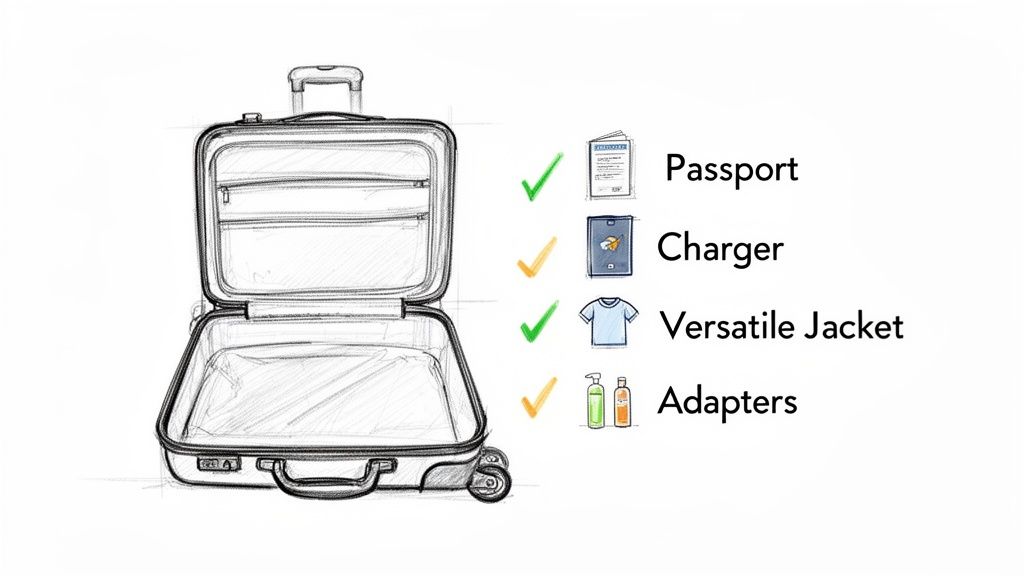
Here’s a practical checklist to guide you:
The Essentials Breakdown
Documents & Money
Passport (check that it has at least 6 months of validity left)
Digital and physical copies of your passport, tickets, and visas
Credit cards and a small amount of emergency cash
Travel insurance details
Electronics
Your phone and a trusty portable power bank
A universal travel adapter (most of Europe uses the Type C/F plugs)
All your charging cables
The Capsule Wardrobe
A couple of pairs of versatile pants or jeans
Several neutral tops you can layer
One or two slightly dressier outfits for nice dinners
A lightweight waterproof or windproof jacket
Comfortable walking shoes. This is non-negotiable. Break them in before you go!
Health & Toiletries
A small first-aid kit with pain relievers, blister bandages, and antiseptic wipes
Any personal prescription medications (in their original bottles)
Travel-sized toiletries to get you started
Packing this way isn't about restriction; it's about freedom. You'll have everything you need without feeling weighed down, letting you navigate your incredible European adventure with ease. Your back will thank you later.
A Few Lingering Questions Answered
Even after you’ve sketched out the basics, a few nagging questions always seem to pop up. It happens to even the most seasoned travelers! Let’s clear up some of the most common uncertainties we hear about when people plan a Europe trip.
How Far in Advance Should I Plan a Trip to Europe?
If you’re aiming for the best prices and your pick of accommodations, the sweet spot for planning is six to nine months ahead. I can't stress this enough, especially if you have your heart set on traveling during the peak summer months from June to August.
Starting this early gives you a massive advantage. You’ll be able to book flights and those charming, well-located hotels before they sell out or the prices become eye-watering. The same logic applies to booking high-speed trains within Europe; grabbing those tickets about two to three months before you go can lock in much lower fares.
Is a Multi-City Trip Cheaper Than Staying in One Place?
Honestly, not always. While you might save a bit by not booking a round-trip flight to a single city, a multi-city journey introduces its own costs for trains, short-haul flights, or buses between destinations.
The secret to an affordable multi-city trip is smart routing. A logical route connecting nearby cities—think Amsterdam to Brussels to Paris on the train—is a beautiful and cost-effective way to travel. On the other hand, zig-zagging across the continent from Lisbon to Istanbul and then back to Barcelona will burn a hole in your budget with extra flight costs and wasted travel days.
A multi-city trip often delivers more value for your time, even if it's not always cheaper. Waking up in three different cultural capitals over a week is an experience a single-city trip just can't match.
What Is the Best Way to Handle Money in Europe?
My go-to strategy is a simple one: don't put all your eggs in one basket. Rely on a mix of payment methods. For big-ticket items like hotels, nice dinners, and major tour bookings, use a credit card that has no foreign transaction fees. This is a non-negotiable feature that can easily save you hundreds of dollars on a longer trip.
As soon as you arrive, find a real bank ATM (not a sketchy standalone one) and withdraw a modest amount of local currency. This cash is perfect for the fun stuff—a coffee, street food, souvenirs from a local market, or leaving a tip.
One thing to absolutely avoid: exchanging piles of cash at airport currency kiosks. Their exchange rates are notoriously bad. A bank ATM will give you a far better deal, every time.
Do I Really Need Travel Insurance for Europe?
Yes. Absolutely. Even if it isn't a mandatory requirement for your entry, traveling without insurance is a gamble you just don't want to take. Consider it a non-negotiable part of your budget, right alongside flights and hotels.
Think of it this way: travel insurance is your financial safety net for all the things that can go wrong. It provides coverage for:
Medical Emergencies: Healthcare abroad can be incredibly expensive.
Trip Cancellations: Get your non-refundable deposits back if you have to cancel for a covered reason.
Lost or Stolen Luggage: It helps you replace essentials if your bags go missing.
Travel Delays: Covers extra food and lodging costs during a major delay.
For a relatively small investment, travel insurance gives you critical protection. More importantly, it gives you peace of mind. Knowing you’re covered lets you relax and enjoy the vacation you worked so hard to plan.
Group travel planning can be tough, but it doesn't have to be. MyPerfectStay replaces messy group chats and endless debates with a simple, fair system. Everyone takes a quick private survey, and our algorithm finds the perfect activities for your whole group to vote on and book in one click. Plan your next trip without the stress at MyPerfectStay.

Alle Seiten
Resources
FAQ’s
Häufig gestellte Fragen
Hier findest du Antworten auf die wichtigsten Fragen zu MyPerfectStay – zu Funktionen, Buchung und wie Gruppenplanung bei uns funktioniert.
Müssen wir eine App herunterladen?
Wie funktioniert der „Match Score“?
Können wir für die ganze Gruppe auf einmal buchen?
Braucht jeder einen Account oder Login?
Können wir eine Voting-Deadline setzen?
Ist das Buchen über MyPerfectStay sicher?
Hol dir MyPerfectStay für deine nächste Reise
Erstelle einen Tagesplan, auf den sich eure ganze Gruppe einigt – ohne Kompromisse.



300K+
Aktivitäten
190+
Länder
Schick uns eine Nachricht
Sag uns kurz, worum’s geht – wir antworten innerhalb von 24–48 Stunden.

Gruppenreisen, endlich gelöst. Plant Trips, die alle lieben – ohne endlose Diskussionen.


Lade unsere App herunter

