Your Ultimate Family Reunion Itinerary Template and Planning Guide

A good family reunion itinerary template is your secret weapon. Think of it less as a rigid schedule and more as a flexible game plan—a way to map out activities, meals, and logistics for a crowd that spans generations.
A great itinerary has breathing room. It perfectly balances the must-do events with plenty of downtime, making sure everyone from your energetic nephews to your great-aunt has an amazing time.
Laying the Groundwork for a Memorable Reunion
Before you dive into booking flights or choosing a rental big enough for the whole clan, you need to take a step back. The best reunions start with a simple conversation to get everyone on the same page. This initial planning phase is all about turning that chaotic family group chat into a clear vision.
Let's be honest: planning a group trip can be like herding cats. Getting this groundwork right from the start saves you countless headaches later. The goal is to find that happy medium where Grandma’s dream of a quiet garden tour in Paris can coexist with the cousins’ desire for a thrilling desert safari in Dubai.
First, Take the Family’s Temperature
Your first job is to get a read on what everyone is actually thinking. The easiest way to do this without accidentally starting a family feud is with a simple online poll. I’ve found that tools like Google Forms or SurveyMonkey are perfect for this.
Here’s what you absolutely need to ask:
The Budget Question: This is the big one. Ask for a comfortable price range per person or per family (e.g., under €1,000, €1,000-€2,500, €2,500+). Always make this anonymous to get honest answers.
Trip Length: Keep it simple. Offer options like a long weekend (3-4 days), a full week (5-7 days), or something longer.
Travel Style: What’s the vibe? Give them choices like "Relaxing & Low-Key," "Adventurous & Active," or "Cultural & Educational."
Destination Ideas: Instead of a blank slate which can be overwhelming, offer a few curated choices that fit different styles. You could contrast a historic city break in Rome with a coastal retreat in Dubrovnik, for example.
This data becomes your guide. It ensures the family reunion itinerary template you build is based on what the group genuinely wants, not just what you think they want.
Before you send out that poll, it's helpful to organize your own thoughts. Asking these foundational questions first will help you frame the survey and get the clarity you need to move forward.
Initial Family Reunion Planning Checklist
Planning Step | Key Question to Ask | Why It Matters for Your Itinerary |
|---|---|---|
Set the Core Goal | Why are we doing this? Is it to celebrate a milestone, or just to reconnect? | A 50th anniversary might call for a formal dinner, while a casual get-together is all about unstructured fun. |
Gauge the Budget | What is a realistic budget range per family that won't cause financial stress? | This is the single biggest factor that will determine your destination, activities, and accommodation. |
Establish a Timeline | When is the best time of year for everyone to travel, considering school and work? | Nailing down a season or specific month helps you narrow down destinations and start tracking flight deals. |
Assess the Group | Who is coming? How many kids, teens, adults, and seniors will be there? | The age mix directly impacts the pace, accessibility needs, and types of activities you'll plan. |
Getting these answers upfront creates a solid foundation, making every subsequent decision—from picking a destination to planning daily activities—so much easier.
By asking for input with a simple survey, you subtly shift the responsibility from just one person to the entire group. It’s no longer your trip to plan; it’s the family’s adventure to choose together.
Navigating the Logistics of a Modern Reunion
Bringing family together often means coordinating travel from different cities, states, or even countries. This gets even more complicated when you’re planning an international trip, where travel policies can and do change.
For instance, the logistics of large-scale family movements are always evolving. In the Netherlands, 16,500 people arrived for family-related reasons in 2025, a 38% surge from the year before. While your reunion might not be on that scale, it shows how family travel—big and small—is a constant. You can even read more about family reunification trends to see how these movements are tracked.
This is exactly why having a clear plan is so critical. Your itinerary is more than just a schedule; it’s a communication hub. It aligns everyone on dates, locations, and expectations, which is essential when you have family members flying in from all over the world. A well-organized template gives you the clarity and confidence to manage all those moving parts.
From Vision to Itinerary: How to Craft Your Perfect Plan
A brilliant idea for a family reunion is one thing, but a solid plan is what makes the magic happen. Think of the downloadable family reunion itinerary template not as a strict schedule, but as your starting point—a flexible guide you'll shape to match your family's unique vibe.
From my experience, the biggest mistake planners make is over-scheduling. The secret to a happy multi-generational trip is finding that sweet spot between organized activities and pure, unscheduled downtime. This is especially true when you’ve got toddlers who need naps and grandparents who’d much rather sip their coffee than rush to another tour.
A good way to start is by figuring out your group’s overall mood. Are you craving a relaxed, slow-paced getaway or an action-packed adventure? This simple choice helps you narrow down your options from the very beginning.
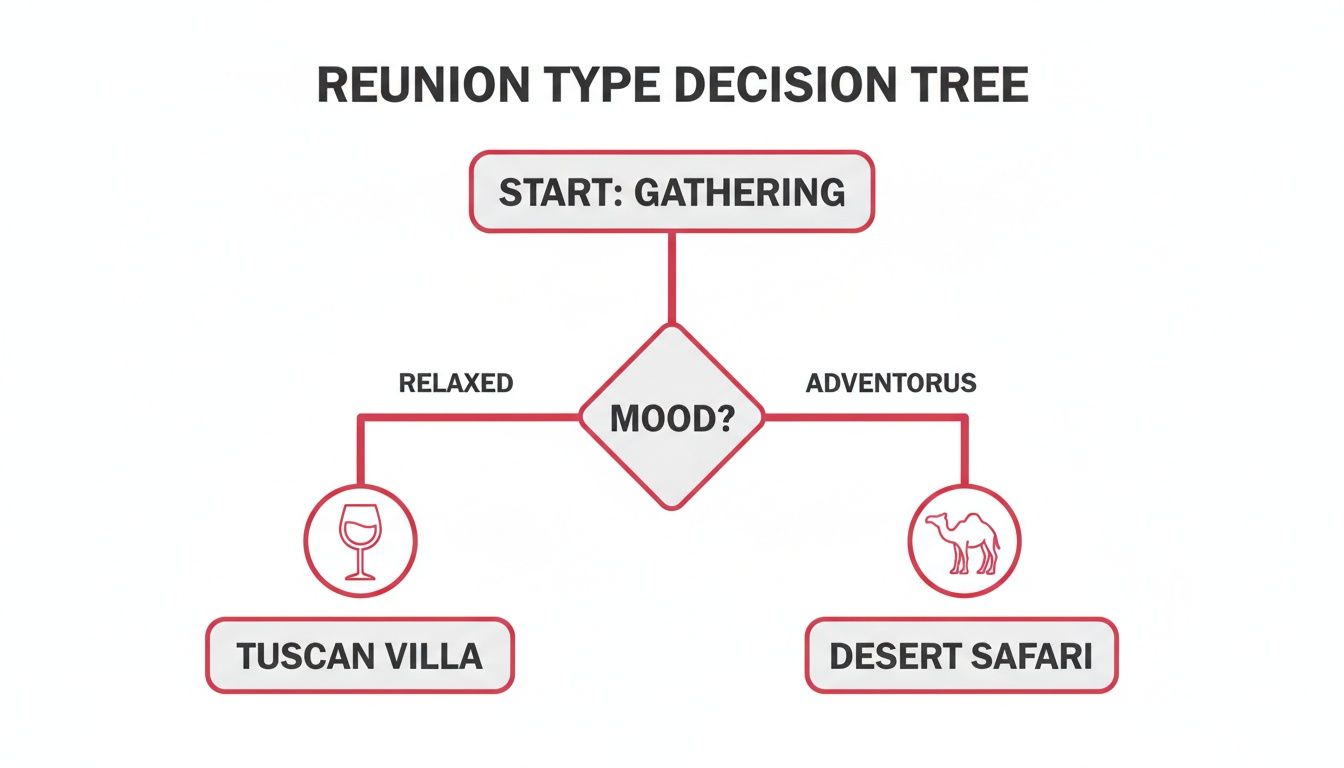
Once you know the feeling you're going for, you can start building a schedule that actually works for everyone.
Structuring Your Days with Activity Blocks
Instead of packing your days from minute to minute, try thinking in "activity blocks." This method gives your days a gentle rhythm without feeling restrictive. It gives people a clear idea of what's happening, so they can easily decide to join in or take a break.
We find it helps to group these blocks by energy level and interest.
Examples of Activity Blocks:
Cultural Deep Dive: These are your headliner events, the big memory-makers. Think a guided tour of the Alhambra in Granada, exploring the sprawling Roman Forum, or wandering through the ancient city of Petra in Jordan.
Relaxed Connection: This is all about low-key bonding. It could be a picnic in Amsterdam's Vondelpark, a lazy afternoon stroll along the Seine in Paris, or just watching the sunset from your villa overlooking the Santorini caldera.
Adventure Hour: For the thrill-seekers in the bunch! This might be kayaking along the Dubrovnik coastline, a heart-pumping camel ride in the Dubai desert, or zip-lining through a rainforest canopy.
Free Exploration: Don't underestimate the power of downtime. This unscheduled block is essential for letting people recharge, hunt for souvenirs, nap, or just find a quiet corner with a book.
By mixing and matching these blocks, you create a balanced itinerary that prevents burnout. A great day might start with a "Cultural Deep Dive," open up into "Free Exploration" in the afternoon, and come together for a shared meal in the evening.
Using Smart Tools to Finalize Activities
Let's be honest: one of the hardest parts of planning is getting a group of people to agree on anything. The endless group chat debates can quickly lead to frustration. This is where modern planning tools can be a real lifesaver.
Rather than trying to guess what your cousins and grandparents want to do, you can present a handful of great options and let everyone vote. Platforms like MyPerfectStay can take everyone's private votes—considering their interests, budget, and even preferred energy level—and instantly show you which activities have the most group consensus.
This takes all the drama and guesswork out of decision-making. You're no longer the stressed-out planner trying to read everyone's mind. Instead, you're just guiding the group toward a decision they've already made together.
It works beautifully. Imagine you're planning a reunion in Lisbon and can't decide on an afternoon activity. You could propose three options:
A historic tram ride through the Alfama district (low energy)
A food tour focused on pastéis de nata (medium energy)
A visit to the Belém Tower and Monastery (more walking involved)
The family votes privately. The results come in, and you see that 75% of the group is thrilled about the food tour. Just like that, you can book it with confidence, knowing it's something the vast majority will genuinely love. For more inspiration, our guide on family reunion activities for all ages has plenty of ideas to get you started.
This approach turns planning from a chore into a fun, collaborative project. It ensures your final itinerary is something everyone feels excited about, paving the way for a truly unforgettable trip.
Sample Itineraries to Get You Started
Staring at a blank itinerary template can feel a little overwhelming. So, to get your creative juices flowing, I’ve put together three sample itineraries based on real, successful family reunions. Don't think of these as rigid rules, but as starting points you can twist, borrow from, and completely make your own.
The secret to a happy multi-generational trip is always the same: balance. You need a mix of planned group fun and genuine downtime. You’ll see how each of these examples builds in that breathing room, giving people the freedom to connect without feeling overscheduled.
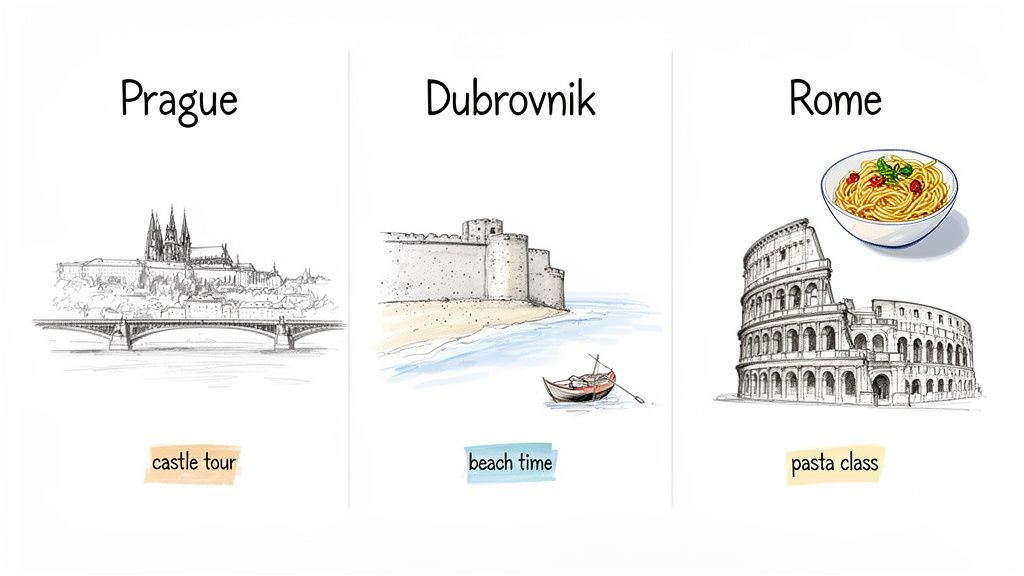
Example #1: The Weekend City Escape in Prague
A shorter, high-energy get-together in a historic city can be a fantastic option. This itinerary keeps the pace lively but includes plenty of moments for everyone to catch their breath.
Day 1: Arrival & Old Town Charm
Afternoon (Low-Key): As family members trickle in and settle into their accommodations, the first "official" event is a super casual meetup in the Old Town Square. This takes the pressure off a hard start time.
Evening (Group Focus): A welcome dinner at a traditional Czech restaurant. A pro tip: pre-booking and choosing a set menu saves a world of headache when you're dining with a crowd.
Day 2: Castles, Cruises & Choices
Morning (High Energy): Time for the main event—a guided tour of the stunning Prague Castle. If you have guests with varying mobility, hiring a private guide who can adjust the pace is well worth it.
Afternoon (Relaxed): Everyone gets to put their feet up during a Vltava river cruise. It’s a brilliant way for grandparents and kids alike to see the city's best sights without a ton of walking.
Evening (Flexible): I call this the "Choose Your Own Adventure" night. Offer a few curated restaurant suggestions for smaller groups to try, then plan to meet up later for a final drink.
Day 3: A Farewell Brunch
Morning: One last get-together over a farewell brunch at a cozy café before people start heading for the airport. It's the perfect, relaxed way to say goodbye.
Example #2: The Coastal Retreat in Dubrovnik
If your family is more about sunshine and sea breezes than bustling city streets, a coastal destination like Dubrovnik is pure gold. This itinerary is all about relaxation and soaking in the scenery.
Day 1: Settle In & Sunset Magic
Afternoon: Everyone arrives at your seaside villa or apartments. The first few hours are intentionally blank—perfect for unpacking, a quick swim, or a much-needed nap.
Evening: An unforgettable walk along the famous Old Town walls as the sun goes down. The light is magical, and the air is cooler. Afterward, grab a casual dinner of pizza or fresh seafood.
Day 2: Island Hopping Adventure
Full Day: Chartering a private boat to the Elaphiti Islands is an incredible splurge that pays off in memories. You can swim in quiet coves, explore tiny fishing villages, and have lunch served right on board, all on your own schedule.
Day 3: Beach Time & Free Exploration
Morning: Set up camp at a family-friendly spot like Banje Beach. The adventurous can try water sports while others just relax with a good book.
Afternoon: This is designated "Free Exploration" time. Let people wander the Old Town's marble streets, hunt for souvenirs, or duck into a museum on their own.
Evening: Cap off the trip with a special farewell dinner at a restaurant with panoramic views of the Adriatic—a perfect moment to celebrate being together.
A great itinerary isn't just about what you do—it's about how you feel. By intentionally scheduling downtime, you give people the freedom to connect organically, which is often where the best memories are made.
Example #3: The 7-Day Cultural Deep Dive in Lisbon
To give you an idea of what a longer, more immersive trip might look like, here’s a sample 3-day itinerary from a week-long reunion in Lisbon. It blends iconic sights with hands-on fun, a combination that works wonders for keeping everyone from teenagers to grandparents engaged.
Sample 3-Day Family Reunion Itinerary in Lisbon
Day | Morning Activity | Afternoon Activity | Evening Activity |
|---|---|---|---|
Day 1 | Arrive & Settle In. Casual walk through the Alfama district. | Relax & Unwind. Optional visit to St. George's Castle for those with energy. | Group welcome dinner with Fado music performance. |
Day 2 | Guided tour of Belém Tower & Jerónimos Monastery. | Famous Pastel de Nata tasting at Pastéis de Belém. | "Free Choice" dinner night. Provide a list of recommended restaurants. |
Day 3 | Tram 28 ride through the city’s historic neighborhoods. | Interactive Tile Painting Workshop (great for all ages!). | Farewell family BBQ or catered dinner at the rental property. |
This structure gives a taste of the city's history and culture while building in activities that are purely for fun, like the tile painting workshop—a huge hit every time. For a full 7-day trip, you'd simply expand on this, adding day trips, free days for rest, and more opportunities for small-group exploration.
Organizing these gatherings, especially when family is spread far and wide, is a massive undertaking. The logistics can feel monumental, but the drive to connect is a powerful human need. It's a reminder of what truly matters, a sentiment echoed in situations far more complex than vacation planning. For instance, in the year ending September 2025, the UK government granted 20,876 Refugee Family Reunion visas, marking an 11% increase from the previous year. While the context is different, these numbers underscore the profound importance of family and the lengths people will go to be together.
Ready for more inspiration? Take a look at our guide to the best destinations for family reunions to find the perfect backdrop for your own get-together.
Managing Logistics and Planning for the Unexpected
You've spent weeks crafting the perfect family reunion itinerary, but a great plan on paper is just the beginning. The real magic—the part that makes a trip feel seamless and stress-free—comes from nailing the behind-the-scenes logistics. This is where you shift from dreamer to doer, tackling the details that turn a good idea into an unforgettable reality.
Think of it as the invisible framework holding your reunion together. When the group transportation shows up on time and everyone has their ticket to the museum, it’s because someone handled the nuts and bolts. Get this right, and your itinerary becomes a flexible guide for adventure, not a fragile script waiting to break.
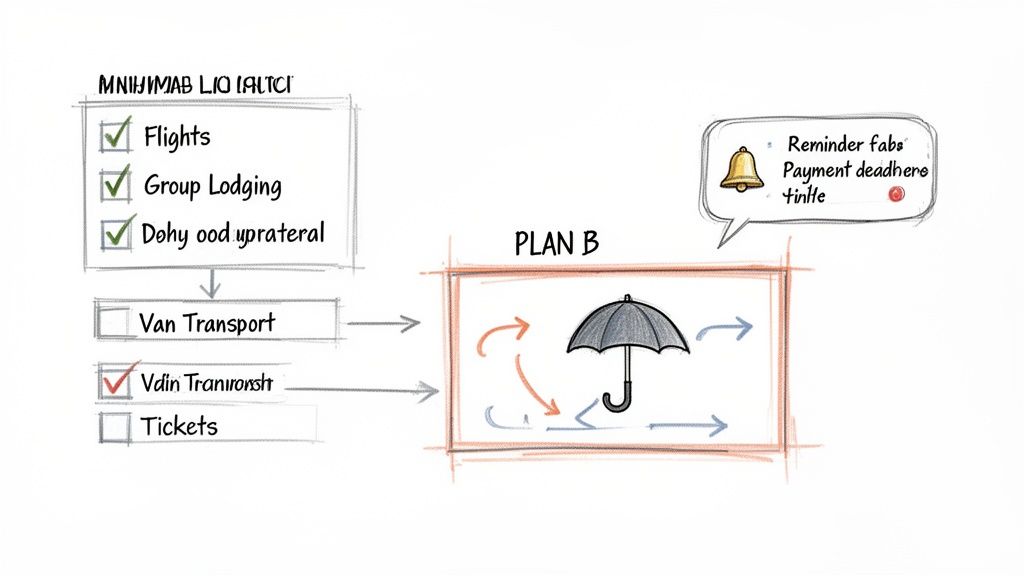
The Essential Logistics Checklist
Once your destination and dates are set, it’s time to get booking. I’ve found the best way to manage this is with a master spreadsheet that the whole planning crew can access. It prevents chaos, like two cousins accidentally booking different airport shuttles.
Here’s what you should focus on locking down first:
Group Flights: Try to get everyone to land within a few hours of each other. It makes airport pickups so much simpler. If you have 10 or more people flying together, it's always worth a call to the airline's group sales department to see if you can snag a discount.
Accommodations: Book your lodging as early as possible, especially if you're headed to a hot spot like Paris or Rome. A large villa, a block of apartments, or connecting hotel rooms are gold. Always double-check for kitchens and common areas—they’re the heart of family bonding time.
Ground Transportation: How are you getting 15 people from the airport to a villa on the Amalfi Coast? Don't leave it to chance. Pre-booking a large shuttle or multiple vans is a must. For getting around day-to-day, a multi-passenger van rental or a deep dive into local transit passes can save you a ton of headaches.
Activity & Tour Tickets: For must-see places like the Louvre or Barcelona's Sagrada Família, pre-purchasing tickets online is non-negotiable. Seriously. You’ll bypass hours-long queues and, more importantly, guarantee entry, as many attractions now sell out weeks ahead.
Getting these big items checked off your list is a huge part of successful trip planning. For an even deeper look at managing group travel, our guide on how to plan a group trip has tons of extra strategies.
The Art of Contingency Planning
No matter how meticulous you are, things can and will go sideways. It's a law of travel. The forecast calls for a surprise thunderstorm on your planned beach day in Dubrovnik, or you discover the museum you wanted to visit is closed for a local holiday. The trick isn't to avoid problems—it's to have a great Plan B ready to go.
A truly resilient itinerary has these backups built right in. For every major outdoor activity, just ask yourself: "What will we do if it rains?" That little bit of forethought can completely save the mood and keep the fun going.
Expert Tip: Your Plan B doesn't need to be complicated. Sometimes the best backups are simple and indoors. Think of it as your 'in case of emergency, break glass' fun kit.
Let's imagine your family is in Marrakech and a sudden sandstorm cancels your desert tour. What now?
Main Event (Plan A) | Potential Problem | Backup Plan (Plan B) |
|---|---|---|
Amalfi Coast Beach Day | Heavy rain and thunderstorms | Pivot to an indoor pasta-making class in a nearby town, followed by a long, cozy lunch. |
Exploring the Souks in Marrakech | Overwhelming heat or unexpected closure | Escape to the cool, tranquil Majorelle Garden and then unwind at a traditional hammam (spa). |
Guided Bike Tour in Amsterdam | A family member feels unwell or tired | They can take a relaxing canal cruise instead and meet up with everyone for dinner later. |
The final piece of this puzzle is communication. When the plan changes, you need to get the word out fast. A dedicated WhatsApp group is perfect for this. It lets you send a quick update to everyone at once, turning a potential moment of chaos into a smooth, coordinated pivot.
Getting It Over the Line: Finalizing Plans and Building the Hype
You’ve done the heavy lifting. You’ve wrangled opinions, scouted locations, and put together a brilliant draft itinerary. Now comes the most satisfying part: turning that plan into a locked-in reality that has everyone buzzing.
This is where we move from spreadsheets to actual excitement. It's all about making those final calls, getting everyone on board, and starting the official countdown. The goal is to make this last step feel less like herding cats and more like the fun is already starting.
Lock in Activities Without the Drama
Getting a final, definitive "yes" on activities that need booking and pre-payment can feel like the final boss battle. This is where a little tech can go a long way in keeping the peace. Instead of endless back-and-forth in the group chat, you can let a group voting tool do the work for you. Platforms like MyPerfectStay are built for exactly this scenario.
Here’s how I’ve seen this play out beautifully.
Offer a few great choices. Based on what you already know from your feelers, put a few curated options on the table for a specific time slot. For a Saturday afternoon in Barcelona, you might propose a tour of the whimsical Park Güell, a guided wander through the historic Gothic Quarter, or a breezy catamaran cruise.
Let everyone vote privately. Each person can rank their top picks without any pressure. This is huge, as it lets people be honest about their budget or how much energy they'll have.
The winner is revealed. The tool simply adds up the preferences and shows you which activity is the clear favorite for the group.
Suddenly, the decision isn't on you. The data shows what the family truly wants. You can go ahead and book that catamaran cruise with total confidence, knowing it has the group's official seal of approval.
This simple shift changes the dynamic from you telling everyone what you’re doing to the group deciding together. It gives everyone ownership, which is the secret ingredient to getting people genuinely excited for the trip.
Keep the Momentum Going
Once everything is booked, you have to bridge the gap between now and the trip itself. The weeks or months of waiting can zap the energy if you're not careful. Your role now is to be the hype-person and chief information officer.
Think about the sheer scale of families coming together across the globe. The logistics can be mind-boggling. The OECD’s International Migration Outlook for 2025 highlights just how complex this can be on a global scale. In the UK, for example, Refugee Family Reunion grants hit a record 20,876 by September 2025. That’s a staggering number of people navigating immense logistical and emotional hurdles to be together. You can learn more about these international migration dynamics from the OECD.
If governments and organizations can coordinate such massive movements, we can definitely manage our crew! Modern planning tools can sift through over 300,000+ bookable experiences, using smart algorithms to find what works best for everyone, whether it's museum tours in Paris or food tastings in Marrakech. The key is precision and clear communication.
Create a Central Info Hub
Having one single place for all trip information is non-negotiable. This prevents a thousand questions from hitting your inbox. A private Facebook group, a shared Google Doc, or a dedicated trip page on a site like MyPerfectStay works perfectly.
Make sure this one-stop-shop includes:
The final, detailed family reunion itinerary template.
All confirmation numbers (flights, hotels, tours).
A fun countdown clock.
Clear payment deadlines and reminders.
A shared photo album for people to post old family pictures to get the nostalgia going.
Set up automated reminders for key dates, like when the final payment for the villa is due. These friendly nudges do the awkward follow-ups for you. By making these final steps collaborative and organized, you're not just planning a trip—you're building the anticipation for a reunion that’s unforgettable from start to finish.
Common Family Reunion Planning Questions
Even with a perfect template in hand, planning a family reunion brings up some tricky questions. Let's be honest, getting a big group on the same page is a challenge. Here are some of the most common hurdles I've seen and how to clear them with a bit of planning.
How Far in Advance Should I Plan a Family Reunion?
The real answer? It depends entirely on the scale of your reunion.
If you're dreaming of a big, multi-generational trip with family flying in from all over—say, to Europe or the MENA region—you need a long runway. Start planning at least 9-12 months ahead. This gives everyone enough time to request vacation days, hunt for flight deals to places like Rome or Dubai, and budget for the trip.
For a smaller, more local gathering, a 4-6 month window is usually plenty. The most important thing is to get a "save-the-date" out as soon as you've loosely decided on a timeframe and location. This gets the reunion on everyone’s calendar before it fills up.
What Is the Best Way to Handle Money for a Large Group?
When it comes to group finances, transparency and flexibility are your best friends. The easiest way to avoid awkward conversations is to start with a private survey to ask about everyone's budget. This simple, confidential step ensures you're planning a trip that everyone can actually afford and enjoy without financial stress.
From there, try to build an itinerary with a good mix of paid and free activities. You could balance a ticketed museum visit with a long, relaxing walk through a beautiful park in Vienna or an afternoon spent wandering the vibrant Gothic Quarter in Barcelona.
For shared expenses like a big villa rental or a catered group meal, an app like Splitwise is a lifesaver. It tracks who paid for what, making it simple and painless to settle up at the end of the trip.
How Do I Create an Itinerary That Appeals to All Ages?
The key to a successful multi-generational itinerary is a blend of balance and choice. The biggest mistake you can make is over-scheduling everyone from dawn till dusk.
Instead, I always suggest planning just one main "anchor" activity each day that most of the family can participate in, like a relaxing boat tour on the canals of Amsterdam.
Then, you can offer optional "breakout" activities for different interests and energy levels. While some family members go on a challenging hike, others might be happier relaxing at a café or exploring local shops. Crucially, build in plenty of downtime for naps, solo wandering, or just sitting around and chatting. A good family reunion itinerary template should clearly label activities as "low-energy" or "active" so people can easily see what fits them best.
An itinerary that offers choice empowers family members to design a vacation that feels right for them. It’s the difference between a schedule they have to follow and an experience they get to co-create.
What Should I Do If Family Members Disagree on Activities?
This is where a little bit of data can save you from endless group chat debates. Instead of letting the loudest voices dominate, use a survey or a planning tool where everyone can privately rank their top activity choices. This process quickly shows you what the majority is most excited about, turning a subjective argument into a simple group decision.
If you find there's still a clear split—say, half the group wants to visit the Louvre in Paris while the other half wants to take a local cooking class—embrace it! Plan parallel activities. Everyone can then come together for dinner and share stories from their different adventures, which often leads to the best memories anyway.
Planning a group trip that pleases everyone is tough, but it doesn’t have to be. MyPerfectStay replaces messy group chats with smart, data-driven decisions. Let our voting tools find the perfect activities for your family, so you can book with confidence and focus on what really matters—making memories together. Start planning your unforgettable reunion today.

Alle Seiten
Resources
FAQ’s
Häufig gestellte Fragen
Hier findest du Antworten auf die wichtigsten Fragen zu MyPerfectStay – zu Funktionen, Buchung und wie Gruppenplanung bei uns funktioniert.
Müssen wir eine App herunterladen?
Wie funktioniert der „Match Score“?
Können wir für die ganze Gruppe auf einmal buchen?
Braucht jeder einen Account oder Login?
Können wir eine Voting-Deadline setzen?
Ist das Buchen über MyPerfectStay sicher?
Hol dir MyPerfectStay für deine nächste Reise
Erstelle einen Tagesplan, auf den sich eure ganze Gruppe einigt – ohne Kompromisse.


300K+
Aktivitäten
190+
Länder
Schick uns eine Nachricht
Sag uns kurz, worum’s geht – wir antworten innerhalb von 24–48 Stunden.

Gruppenreisen, endlich gelöst. Plant Trips, die alle lieben – ohne endlose Diskussionen.


Lade unsere App herunter

