Your Guide to Travel Agency Payment Plans in 2026
That number staring back at you from the screen can be a real showstopper. Travel agency payment plans are designed to take the sting out of that initial sticker shock, letting you secure your vacation now and pay for it over time. Instead of one massive, upfront payment, you can break it down into smaller, more manageable chunks.
How Travel Payment Plans Make Dream Trips a Reality
Let's say you're the brave soul organizing a group trip to a sun-drenched villa in Santorini. The total cost is hefty, and you just know that asking everyone to fork over their entire share right away is a recipe for chaos and last-minute dropouts. This is exactly where a travel agency payment plan can save the day.
Think of it less like a loan and more like a layaway program for your next adventure. The plan splits the total cost into a series of scheduled payments. You lock in your trip with a reasonable deposit, then chip away at the balance over the weeks or months before you fly.
Suddenly, that trip doesn't feel so out of reach. Budgeting for a week exploring Rome's ancient streets or haggling in the vibrant markets of Marrakech becomes predictable and far less stressful. It completely changes the financial dynamic.
Turning "Someday" into "Booked"
For most of us, the biggest hurdle to traveling more isn't a lack of wanderlust—it's coming up with a large lump sum of cash on demand. Payment plans tackle this problem head-on.
By spreading the cost out, you can lock in today's prices for flights and hotels. This is huge, as it protects you from the inevitable price hikes that pop up the closer you get to your travel date. It gives you the confidence to plan further ahead.
This approach is a game-changer for those bigger, once-in-a-lifetime trips that require a bit more planning and a larger budget. For example:
A multi-city European tour: Juggling the costs of Paris, Amsterdam, and Barcelona is much easier when you can spread payments over six months or more.
A luxury desert escape: That all-inclusive resort in Dubai for a milestone birthday feels a lot more attainable with a structured installment plan.
A group celebration: Coordinating a bachelor party in Prague or a big family reunion on the Amalfi Coast becomes simpler when everyone can manage their own payment schedule.
Ultimately, these plans help shift your focus from the financial stress to the excitement of the journey ahead. They make it possible for solo adventurers, couples, and large groups to stop dreaming and start packing. It's a simple financial tool, but it’s what makes seeing the world a genuine possibility for so many more people.
What Kinds of Travel Payment Plans Are There?
So, you've decided a payment plan is the right move for your next big adventure. Smart choice. But you’ll quickly find that not all plans are created equal. Travel agencies have a few different models, each designed for different kinds of trips and travelers.
Figuring out which one fits you best is the key to a stress-free booking, whether you’re planning a once-in-a-lifetime journey or a quick weekend escape.
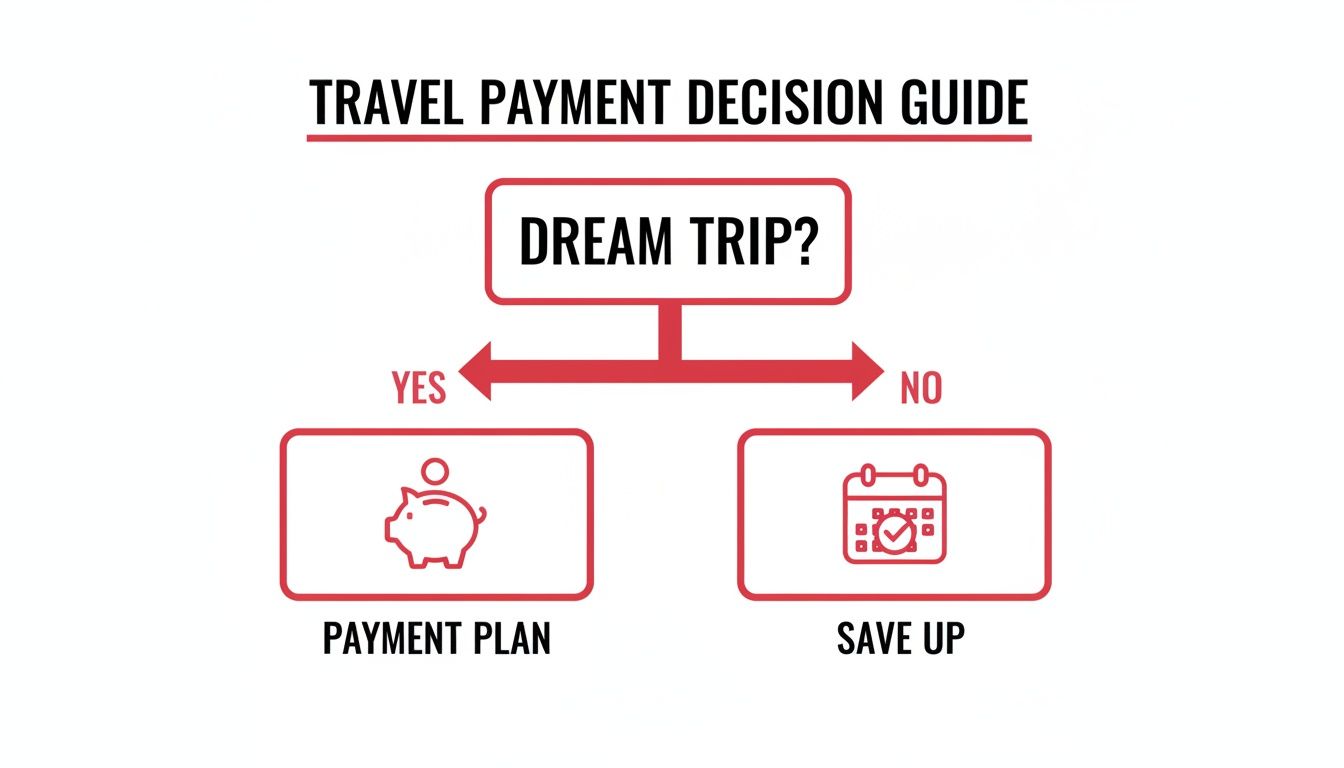
This simple chart nails it: for that dream trip, a payment plan is a brilliant tool. For smaller getaways, you might just want to save up. Let's walk through the main types of travel agency payment plans you're likely to come across.
The Classic Deposit and Final Balance
This is the old-school, tried-and-true method. It’s perfect for people who like to plan far ahead—sometimes a year or more before they even pack their bags.
Here’s how it works:
The Initial Deposit: You put down a small chunk of the total cost right away to secure everything. This locks in your spot and, just as importantly, the price for your flights, hotels, and tours.
The Final Balance: The rest of the money is due in one lump sum, usually 60 to 90 days before you leave.
Think of booking a luxury cruise through the Greek Isles for next summer. You pay a deposit now, guaranteeing your cabin and locking in today's price. Then, you have almost a full year to save up for the final payment. It gives you peace of mind and plenty of time to budget without the stress of monthly bills.
Scheduled Installment Plans
If you're someone who loves predictability, scheduled installment plans are your best friend. This approach simply carves up the total cost of your vacation into a set of equal, manageable payments. It’s almost like a subscription for your trip.
The real beauty of this is its predictability. You know exactly what’s due and when, making it easy to fit the cost into your monthly budget without any surprises down the road.
This is a fantastic setup for medium-term planning, like that all-inclusive family resort you want to book six months from now. Your agent will create a payment schedule for you. For example, a €3,000 trip to the Canary Islands could be structured with a €500 deposit and then five monthly payments of €500. Simple and straightforward.
Travel Layaway Plans
You've probably heard of layaway at department stores, and this is pretty much the same idea but for travel. You make payments over time, but there's one major catch: your trip isn't officially booked or ticketed until the entire balance is paid off.
It's not as common these days, but it's a good option if you want to commit to a vacation package without being locked into a non-refundable booking right away. It's a low-risk way to save for a specific trip. The downside? You can't be 100% sure your booking is secure until that final payment is made. Prices or availability could shift in the meantime.
Buy Now, Pay Later Services
The new kid on the block is the "Buy Now, Pay Later" (BNPL) option, which has exploded in popularity. Services like Klarna, Affirm, and Afterpay partner with travel companies to offer instant, short-term financing right at checkout. Your trip is booked immediately, and you pay the BNPL provider back in a handful of installments.
This model is a huge reason the travel industry is booming. The global "Travel Now, Pay Later" market hit USD 45 billion in 2024 and is expected to soar to USD 77.6 billion by 2030. This growth is heavily driven by younger travelers who use these services to book incredible trips without waiting. You can dive into the full market research to see just how fast consumers are embracing this trend.
BNPL is perfect for those spontaneous trips—like a last-minute long weekend in Lisbon—or for anyone who wants the satisfaction of an instantly confirmed booking. Just be sure to read the fine print. Many offers are interest-free, but if you miss a payment, you could get hit with interest or late fees.
Comparing Travel Payment Plan Options
With several ways to pay, it helps to see them side-by-side. This table breaks down the four main types so you can quickly see which one aligns with your financial style and travel timeline.
Plan Type | Best For | Payment Structure | Key Benefit |
|---|---|---|---|
Deposit & Final Balance | Planners who book 9+ months in advance. | Small deposit upfront, with the full remaining balance due 60-90 days before travel. | Locks in rates early with a long runway to save for the final payment. |
Scheduled Installments | Budget-conscious travelers who prefer predictable monthly payments. | Total cost is divided into equal, recurring payments over several months. | Easy to budget for; no financial surprises. |
Travel Layaway | Cautious travelers who want to save for a specific trip without immediate commitment. | Regular payments are made over time; trip is confirmed only after the full amount is paid. | High flexibility and low initial risk, but availability isn't guaranteed. |
Buy Now, Pay Later | Spontaneous travelers and those who want instant booking confirmation. | Trip is paid in full upfront by a third-party service; you repay them in short-term installments. | Instant gratification; book your trip immediately and pay over time. |
Each plan offers a different path to the same goal: making your dream trip happen. The best choice really comes down to how you like to manage your money and how far in advance you're planning.
Reading the Fine Print Before You Commit
A great travel agency payment plan can feel like the perfect on-ramp to your dream vacation, but you have to be careful it’s not a financial tightrope. That low monthly payment for a getaway to Barcelona or Marrakech is definitely tempting. The real value, though, is always hiding in the details.
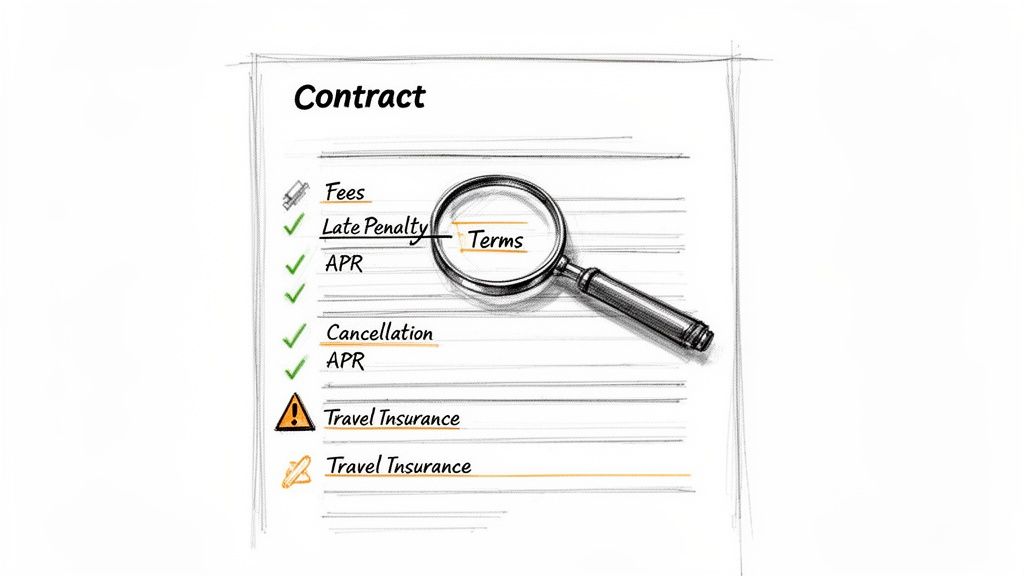
It's so easy to get caught up in the excitement of booking and just skim the terms and conditions. But that document is where the tripwires are. It’s a contract that lays out everything you’re agreeing to, and skipping it can lead to some very expensive surprises.
Uncovering Hidden Costs and Penalties
That affordable plan can get expensive fast if you’re not paying attention. The total cost of your trip isn’t just the sum of your installments; you have to be on the lookout for extra charges that can sneak up and inflate your budget.
Here’s a checklist of potential costs I’ve seen trip up even seasoned travelers:
Administrative or Setup Fees: Some agencies will tack on a one-time, non-refundable fee just for setting up the plan.
Late Payment Penalties: Life happens. But missing a payment deadline could trigger a steep penalty, sometimes adding a nasty percentage to what you already owe.
Interest Rates (APRs): Many direct installment plans are interest-free, which is great. But third-party Buy Now, Pay Later (BNPL) services often charge interest, especially for longer repayment terms. An 18% APR on a big trip can add hundreds of dollars to your total cost.
Card Processing Fees: A few providers might pass on their credit card processing costs to you, usually around 2-3% of each installment.
Think of it like booking a budget flight. The ticket price looks fantastic, but the final cost grows once you add checked bags, choose a seat, and pay for Wi-Fi. It’s the same idea here—you have to account for every fee to know what you're really paying.
Scrutinizing the Cancellation Policy
This might be the single most important part of any travel agreement. Your ability to get your money back if your plans go sideways is entirely dictated by these terms. Policies vary wildly from one company to the next, so you absolutely must know where you stand before putting any money down.
A key question you should always ask is: "If I have to cancel, what happens to the money I've already paid?" The answer is rarely straightforward and usually depends on how close you are to your departure date.
For example, canceling your group trip to Prague six months in advance might mean you only lose your initial deposit. But if you try to cancel just 45 days before you’re scheduled to fly, you could forfeit 100% of everything you've paid so far. Understanding these refund schedules and deadlines is critical. If the language is fuzzy, get clarification in writing. To see a good example of clear, detailed terms, check out the MyPerfectStay Terms and Conditions.
The Role of Travel Insurance
This is where travel insurance becomes your financial safety net. A solid insurance policy is designed to work with your payment plan to protect the money you've invested.
A common mistake is assuming the payment plan itself includes cancellation coverage. It doesn't. The plan is just a tool for spreading out payments; insurance is what protects those payments from being lost.
If you want real peace of mind, look for a "Cancel for Any Reason" (CFAR) policy. It costs more, but it gives you the most flexibility, often reimbursing up to 75% of your non-refundable trip costs if you cancel for a reason not covered by a standard policy. Whether it's a sudden work conflict or you just change your mind, CFAR coverage provides an escape hatch. It ensures that a canceled trip to Rome doesn’t turn into a complete financial loss.
A Step-by-Step Guide to Booking Your Trip
You’ve done the research, you understand the fine print, and you’re ready for the best part: making your trip official. This is where the abstract idea of a vacation starts to feel real. Securing a travel agency payment plan isn't complicated, but knowing the right steps can make all the difference.
Let's walk through how to find the perfect travel partner, get the answers you need, and lock in that dream itinerary with total confidence.
Finding and Comparing Agencies
First things first, you need to find agencies or tour operators that offer the payment flexibility you’re looking for. A simple search for "travel agency with payment plans" or "Amalfi Coast vacation packages with installments" is a good place to start, but that's just scratching the surface.
Once you’ve got a shortlist, it's time to vet them. Look beyond the glossy photos and compare what really matters:
Payment Options: Do they just ask for a deposit and final payment? Or do they offer a proper monthly installment schedule or work with BNPL services? Make sure their system matches your budget.
Expertise: An agent who specializes in European city breaks will know Rome inside and out, offering far more value than a generic booking site. Find someone who lives and breathes your destination.
Reputation: Dig into reviews from other travelers. Look for specific feedback on their payment process, how they handle issues, and whether the trip lived up to the hype.
Asking the Right Questions
You’ve found a promising itinerary—that week-long tour of Rome or a colorful adventure in Marrakech is calling your name. Before you sign anything, it’s time to have a direct conversation. This isn't the time to be shy; get all your questions answered upfront.
Think of it like an interview. You’re vetting the agency to make sure they’re the right partner for your hard-earned money. Clear, confident answers are a great sign. Vague or hesitant replies? That's a red flag.
Here are the non-negotiable questions you need to ask:
What is the total cost of the trip, including every single tax and mandatory fee?
Can you email me a detailed payment schedule, showing the deposit amount and the exact due date for each installment?
Are there any administrative or setup fees for using this payment plan?
What happens if I’m late on a payment? Is there a grace period or a fee?
What is your cancellation policy? I need to know exactly how much I would get back if I had to cancel 90, 60, or 30 days before the trip.
Always get these answers in writing. An email thread creates a paper trail that can be a lifesaver if any confusion or disputes pop up down the road.
Applying and Setting Up Your Plan
Once you've picked an agency and you’re comfortable with the terms, the final part is pretty smooth. You'll formally accept the travel proposal and provide some basic information. Most direct-to-agency installment plans don't involve a credit check, but if you're using a third-party BNPL provider, they might run a quick, soft check that won’t impact your credit score.
You’ll then provide your payment details. Here’s a pro tip: if they offer it, always opt for automated payments. Linking your credit card or bank account ensures each installment is paid on time without you ever having to mark a calendar or set a reminder. Set it and forget it.
A Sample Payment Schedule
Let's see what this looks like in the real world. Imagine you're booking a €3,000 trip to Italy's stunning Amalfi Coast, with your departure set for eight months from now.
A typical installment plan could break down like this:
Payment | Due Date | Amount | Remaining Balance |
|---|---|---|---|
Deposit | At Booking (March 1) | €450 | €2,550 |
Installment 1 | April 1 | €425 | €2,125 |
Installment 2 | May 1 | €425 | €1,700 |
Installment 3 | June 1 | €425 | €1,275 |
Installment 4 | July 1 | €425 | €850 |
Installment 5 | August 1 | €425 | €425 |
Final Payment | September 1 | €425 | €0 |
This structure transforms a big-ticket item into manageable monthly payments. With the final balance paid off a full 60 days before travel in November, everything is settled well in advance. All that’s left for you to do is get excited.
How to Manage Group Travel Payments Without the Headache
Anyone who’s tried to organize a group trip knows the feeling. It starts with an exciting idea—a bachelor party in Prague, a family reunion on the Croatian coast, or a friends' getaway to Dubai. But pretty soon, the money conversation starts, and one person gets stuck being the reluctant group accountant.
Suddenly, you're the one fronting your own cash for deposits, chasing down payments, and trying to make sense of a messy spreadsheet. The group chat blows up with "Who paid what?" and "Wait, how much do I owe again?" It's enough to create serious friction before anyone has even packed a bag.
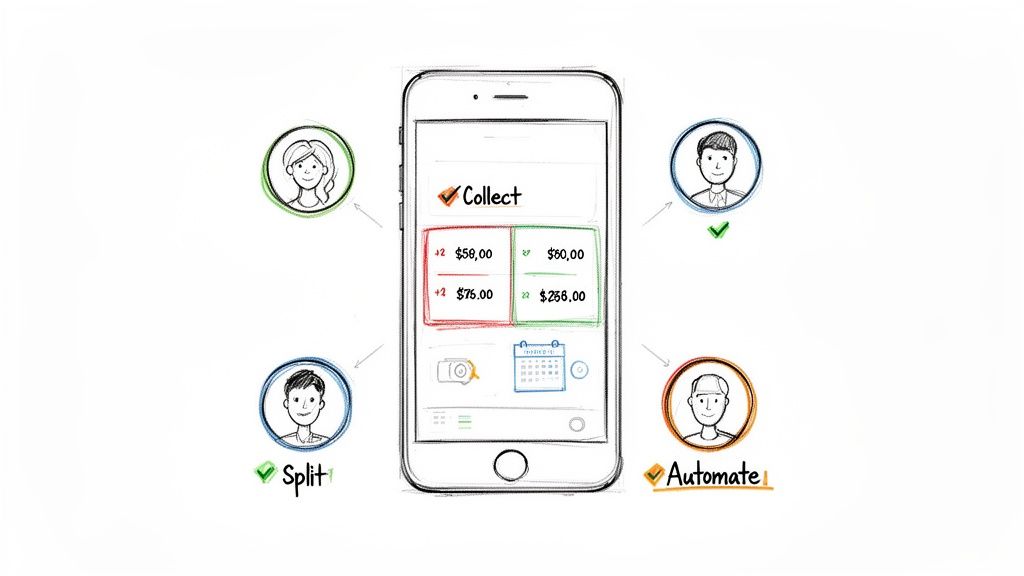
Thankfully, you don't have to rely on spreadsheets and awkward reminders anymore. Modern travel planning platforms were built to solve this exact problem, replacing the headache with smart, automated tools that keep things simple and friendly.
From Chaos to Coordination
The biggest hurdle for any group organizer is getting everyone's money in on time without feeling like a debt collector. This is where dedicated platforms really shine. They automate the entire process, taking the stress off your shoulders.
Think of these platforms as a neutral, digital treasurer for your trip. They send the reminders, track every dollar, and make sure everyone chips in their fair share—all without you having to play the bad cop. It keeps friendships intact and lets everyone focus on the fun part.
This move toward digital coordination isn't just a nice-to-have; it's what travelers now expect. The global online travel market is set to hit a massive $1.2 trillion by 2026. And within that huge market, a full three-quarters of travelers want flexible payment options. The problem is, many booking sites still haven't caught up, especially when it comes to groups. As more people book online, the demand for smooth group payment tools is only getting louder.
Smart Tools for Group Harmony
Specialized platforms are now full of features designed to tackle the specific pain points of group travel. They make the whole financial side of things transparent, fair, and incredibly straightforward.
These platforms usually include:
Smart Budget Voting: Before a single dollar is spent, the group can vote privately on different budget options for accommodations or activities. This gets everyone on the same page about costs right from the start.
Automated Payment Collection: The organizer sets the payment deadlines, and the platform sends automatic reminders to each traveler. No more awkward follow-up texts.
Easy Split-Payment Options: Each person pays their portion directly through the platform with their own card or payment method. This means no single person has to collect a huge pot of money.
Getting this organized from day one is a game-changer for more complex trips. You can get more great tips on keeping everyone aligned in our guide on how to plan a group trip.
Real-World Example: A Bachelor Party in Prague
Let's put this into practice. Imagine you're organizing a trip to Prague for ten friends. The old-school way meant building a complicated spreadsheet, calculating each person's share for the flights and a big Airbnb, and then sending dozens of messages begging for the money.
With a modern platform, the organizer just invites everyone to the trip. The group votes on a few apartment options, and once they choose one, each person gets a notification to pay their €200 share directly. The organizer has a clean dashboard to see who has paid, and the booking is confirmed automatically once the funds are all in. Nobody has to front thousands of dollars or deal with a jumble of bank transfers. It’s this kind of seamless experience that makes travel agency payment plans even more powerful when planning for a group.
The Future of Travel Payments and What It Means for You
If you think travel payment plans are just about spreading out costs, think again. The simple installment plans we've covered are really just the tip of the iceberg. We're on the cusp of a major shift where flexible payments are becoming the engine for a smarter, more connected, and deeply personal way to book travel.
A big piece of this puzzle is artificial intelligence. Picture this: instead of a standard three-month plan, an AI analyzes your budget for that dream trip to Vienna and suggests a payment schedule that genuinely aligns with your personal cash flow. The days of one-size-fits-all are numbered. Your payment plan will soon be as unique as your itinerary, making it easier than ever to say "yes" to those bigger adventures.
Smarter, Faster, and More Secure Transactions
This push for smarter payments isn't just a tech trend; it's being backed by some serious regulatory muscle. New rules are coming into play that are designed to speed up transactions and, more importantly, give you better protection as a consumer.
A perfect example is the EU's upcoming Instant Payments Regulation. This is a game-changer for how money moves, making transactions faster and more secure, which has a direct and positive impact on your travel plans.
What does this actually mean for you? When you book a last-minute getaway to Lisbon or need a refund for a canceled tour in Rome, the money will move almost instantly. This simple change removes the stress of waiting days for payments to clear or for refunds to hit your account, building a whole new level of trust and efficiency into the booking process.
In the corporate world, we're seeing a similar evolution with the rise of virtual cards for business travel. These single-use digital cards add a powerful layer of security, which makes managing expenses for company retreats in places like Dubai or Abu Dhabi far cleaner and less vulnerable to fraud.
An Integrated and Personalized Travel Experience
All these advancements are happening just as the travel market is poised for massive growth. Global travel gross bookings are expected to hit $1.67 trillion in 2025, with online channels making up a staggering $1.1 trillion of that. The EU Instant Payments Regulation, set to take effect in 2026, will mandate 24/7 euro processing, which will dramatically speed up both bookings and refunds.
When you pair these facts with research showing that up to a third of travelers are now considering booking trips with AI's help, the picture becomes clear. We're heading toward a future where paying for travel is completely seamless and powered by intelligent tech. For a deeper dive into these market forces, check out this insightful travel industry analysis.
Ultimately, all signs point to flexible travel agency payment plans being a core part of a much larger movement. For developers and travel tech companies aiming to build the next generation of booking platforms, getting a handle on these shifts is non-negotiable. You can see how we're approaching this by exploring our API access documentation.
Frequently Asked Questions About Travel Payment Plans
Thinking about a payment plan for your next trip? You probably have some questions. Let's clear up a few of the most common ones so you can book with total peace of mind.
Are Travel Payment Plans More Expensive?
Not always, but you have to read the fine print. Many travel agencies offer their own installment plans for packages to places like Dubrovnik or Santorini, and these are often completely interest-free. The price you see is the final price you pay, just broken into manageable chunks.
Where you need to be careful is with some third-party "Buy Now, Pay Later" (BNPL) services. They can charge interest, especially if you stretch the payments out over a longer period. Always ask about one-time setup or administrative fees before you sign on the dotted line.
What Happens If I Need to Cancel My Trip?
This is a big one. Your ability to get a refund comes down to the trip provider's cancellation policy, not the payment plan itself.
Your refund amount almost always depends on when you cancel. Canceling a trip to Paris six months out might result in losing only your deposit, while canceling 30 days before departure could mean forfeiting everything you've paid. This is why purchasing travel insurance is so important—it’s your financial safety net.
Can I Use a Payment Plan for Just Flights or Hotels?
Yes, absolutely, but your options will look a little different. Most traditional travel agencies build their payment plans around full vacation packages. It's just simpler for them to manage one large booking.
For booking individual components, those BNPL services are often your best bet. You can use them directly on many airline and hotel websites to book a flight to Amman or a hotel in London and then pay it off over time.
Does Applying for a Travel Payment Plan Affect My Credit Score?
It really depends on which path you take. Most direct travel agency payment plans don't involve a credit check at all. They’re simply offering a flexible way to pay for a trip you're booking with them.
BNPL services are a different story. To get you approved, many will run a soft credit check, which does not affect your credit score. However, if you're asking for a larger loan or a longer repayment schedule, the provider might perform a hard inquiry. That can cause a small, temporary dip in your score, so always confirm what kind of check they'll be running beforehand.
Planning a group trip shouldn't mean chasing payments. MyPerfectStay simplifies everything by letting your group vote on budgets and then automatically collecting each person's share. See how MyPerfectStay can make your next group adventure seamless.

Alle Seiten
Resources
FAQ’s
Häufig gestellte Fragen
Hier findest du Antworten auf die wichtigsten Fragen zu MyPerfectStay – zu Funktionen, Buchung und wie Gruppenplanung bei uns funktioniert.
Müssen wir eine App herunterladen?
Wie funktioniert der „Match Score“?
Können wir für die ganze Gruppe auf einmal buchen?
Braucht jeder einen Account oder Login?
Können wir eine Voting-Deadline setzen?
Ist das Buchen über MyPerfectStay sicher?
Hol dir MyPerfectStay für deine nächste Reise
Erstelle einen Tagesplan, auf den sich eure ganze Gruppe einigt – ohne Kompromisse.



300K+
Aktivitäten
190+
Länder
Schick uns eine Nachricht
Sag uns kurz, worum’s geht – wir antworten innerhalb von 24–48 Stunden.

Gruppenreisen, endlich gelöst. Plant Trips, die alle lieben – ohne endlose Diskussionen.


Lade unsere App herunter

